
On (Good) Writing
Rules and Reminders, and When To Ignore Them

[Greetings, friends, from Austin, Texas! I am currently in the strange, but necessary, period between drafting and hardcore editing, where I find myself tinkering at the edges of my transcript (and taking way too long to write this essay). When I first started writing books, I would skip this gestation phase after the first draft and dive right into technical editing. I have since learned that my books were worse for it.
Now I treat this interim period as necessary. It’s always no less than two weeks and no more than a month, and, in it, several crucial things happen, all of which can be summed up as zooming out to see the forest (instead of losing it for the trees). The writing community might call this phase developmental edits. It is here that I can address and think deeply about structural and scene deficiencies at a high level before I get bogged down in the tedium of sentence structure and word choice. Are there any setups I didn’t pay off, or any payoffs I didn’t set up? Where is the symbolism not quite right? Where is the dialogue dry, or flat, or lacking the distinctive voice of the character? How can I add sensory details to the scenes I really want to drop readers into? These are the high-level questions I am asking and answering at this stage. I do this to ensure that when I print the transcript (which I will do on July 1), I can turn to the technical editing phase and focus most of my brainpower on sentences and words.
By the time I reach the technical editing phase, I have spent somewhere between four and six months with the creator in the Captain’s chair and the critic in the corner. This is intentional and necessary, and I’ve found the only way to get a book done is to allow myself to write imperfect and unrestrained on the first pass. But it usually means my pages are littered with objects that have entered through my blind spots. For example, in my first draft of my latest book, several things became painfully obvious as I started my review: I use too many adverbs (“quickly” or “subtly”), I filter too much through the eyes of Perceval (e.g., “Perceval watched as…”), I tell where I should show, I hedge experiences and actions instead of letting them stand on their own (“The air seemed to shift...” or “the water began to swirl…”), I use “then” too much as a transition, etc. (See the essay below for specific examples of how I do this.)
Because of this, I’ve found it helpful at this part of the process to refresh my brain on the “rules” of good writing. This usually involves reading (or re-reading) a book on the topic—whether that’s Elements of Style by Strunk and White, Stephen King’s On Writing, C.S. Lewis’s various letters (See On Writing), or this year’s selection, Good Writing by Neal Allen and Anne Lamott. This approach signals to the critic in me that it’s safe to come out of the corner and take the wheel for a little while.
In Good Writing, Neal Allen (Lamott’s husband) sets out 36 rules he picked up over his years of writing for newspapers and periodicals. His list includes rules like “Use Strong Verbs,” “Keep It Active,” “Remove the Boring Stuff,” “Show, Then Tell,” and “Don’t Filter.” It’s a great list, and the book is well worth the (quick) read. His example inspired me to write a few rules of my own—some annexed from those I admire, and others that speak, specifically, to my own biases and blind spots.
It is to my list of rules for good writing, and when to ignore them, that we devote the rest of today’s essay. (If you’re a writer and have a rule (or rules) of your own you hold dear, I’d love to hear ‘em! Drop them in the comments, and I’ll be sure to shout you out in my next iteration of the rules.)]
I believe every serious writer would benefit a great deal from developing a list of reminders for every phase of the writing process. We might call these reminders rules, but they function more like words of wisdom to keep in mind—to be ignored, at our peril, only when appropriate and intentional.
Some of these rules can be culled from convention. These are ones like “show, don’t tell” or “eliminate adverbs” or “use active voice.” But for the list to be of ultimate use to the writer, some rules must be specific to the individual and emerge across the arc of a writer’s career. These are the ones, like “write by ear,” which I learned from the stylings of Lincoln; or “manage the reader’s willpower,” which I adopted after guest teaching a legal writing class; or “unfilter and unhedge,” which protects me from my blind spots. (We need these individual rules because we all have our own unique set of phrases we fall back on too much and spots we’re blind to—shaped by the teachers we had, the books we’ve read, and the life we’ve lived.)
My current working list can be split into two broad categories: (1) drafting phase; and (2) editing phase. This is because these two phases require different mindsets and approaches (at least for me). For my writing to flourish, the editor in me must first be suppressed; for my writing to sing in tune and time, the editor must emerge and ruthlessly delete things that don’t quite fit, regardless of how much the drafter protests. (A principle often referred to as “kill your darlings.”)
My full list (updated on an ongoing basis) is below. I’ve limited it to fourteen… for now. Those noted with an asterisk (*) mostly speak to those writing fiction/fantasy. The first rule (write by ear) is followed by a (!) to indicate that it is my overriding rule of primacy—meaning, it receives deference among all other rules and wins any conflict between them.
The Lumenorean’s Rules for Writing Well
(A) Drafting Phase
Write by ear. (!)
Give them you.
Stone by stone, the castle rises.*
Use placeholders to bypass roadblocks.
Not all days can be great.
When you want to throw it away, don’t.
No ore, no blade.
(B) Editing Phase
Keep only the essential.
Question adverbs and adjectives; use stronger verbs and nouns.
Trust, but manage, the reader.
Feed all five senses in important scenes.*
Protect the bubble.*
Vary your sentences and chapter endings.*
Un-filter and Un-hedge.
The Lumenorean’s Rules for Writing Well
Now that you know the rules, I will offer some brief thoughts on each before leaving you with one great big caveat at the end.
(A) Drafting Phase
Write by ear.
This is my first, and greatest, rule. It is a rule I learned from Lincoln during law school and have held dear ever since. What’s important to remember about this rule is that it will often conflict with many other rules of writing (in this list or others), because sometimes the sound and rhythm of the sentence will demand an extra word or two or three.
Take, for instance, my favorite line in Lincoln’s Gettysburg Address: “The world will little note, nor long remember, what we say here, but it can never forget what they did here.” It’s the type of sentence that sticks with you long after you have read it because of its rhythm. Now imagine someone with a red pen got ahold of that sentence and reduced it, in the interest of pure economy, to this: “The world will forget what we say, but must remember what they did.” It’s not a bad sentence, but it lacks soul. And that’s my point.
If my word isn’t enough, here’s Lewis from a letter to a seventh-grade girl named Thomasine to back me up: “Always write (and read) with the ear, not the eye. You should hear every sentence you write as if it was being read aloud or spoken. If it does not sound nice, try again.”1 “Every sentence should be tested on the tongue, to make sure that the sound of it has the hardness or softness, the swiftness or languor, which the meaning of it calls for…”
Give them you.
This rule applies to delivering the authentic, both in terms of voice and content. First, on the matter of the authentic voice. Most of us, when we start writing, begin by emulating (or trying to emulate) those we admire. We read the authors we love and want to write like them. So we try, and perhaps we even succeed a little. This is, in my view, a good thing, and it goes a long way in teaching us how to write. But sooner or later, we find that writing like them means never writing like ourselves. That is the day we realize that our best writing is the writing that is the purest expression of our inner world. We can never write fully like another because we are not another; our voice is a mixture of everyone we’ve ever read or talked to—tasting more of some than others, but wholly ours and ours alone. Nobody else in this world is the same blend, in the exact proportions, of Lewis, Tolkien, Lincoln, Rilke, Weil, and Professor Michael Stokes Paulsen that I am. It’s my job to honor that and write as much like the ever-evolving me as I can.
On the matter of authentic content (what we choose to write about), I will say only that a good reminder here is to write about the boomerangs—that is, the ideas and stories that keep returning to you. That’s always a good indication that there’s something there speaking to your soul (and how I pick the topics of these essays). To quote Lewis: “Write about what really interests you, whether it is real things or imaginary things, and nothing else. (Notice this means that if you are interested only in writing, you will never be a writer, because you will have nothing to write about.)”2
Stone by stone, the castle rises.*
This is my version of Anne Lamott’s “Bird by Bird” advice applied to fiction and fantasy. When I first started trying to write fiction, I quickly found myself overwhelmed. I had no idea where to start. It wasn’t until I broke chapters down into scenes, and scenes into character actions, that it started to click for me. Every time I thought about writing a book, I was sure I couldn’t; every time I worried instead about writing a scene, I was sure I could. So I broke it down: twenty chapters, each with three to five main scenes. That meant I had to write somewhere between 80 and 100 scenes. At a scene a day, I could have a rough draft done in three months.
All I worry about now when I show up that day is “What scene am I trying to write today?” If I can’t wrap my arms around the scene, I’ll zoom in a little closer and ask what the very next thing the character on the page does. Usually, that is enough to get momentum building.
Now, before writing each chapter, I ask, “What needs to happen in this chapter to get from the last chapter to the next chapter?” Then I write a very rough and grammatically awful paragraph in brackets. Each sentence in that paragraph becomes a scene. And before I know it, scene by scene, a book emerges; stone by stone, the castle rises.
Use placeholders to bypass roadblocks.
Writing is a momentum sport. Something that took me a while to learn is how to use placeholders to avoid getting stuck on an idea during the drafting phase. Occasionally, there will be sections where you can’t quite figure out what you want to say. Or, you know what you want to say, but you can’t find the right words to say it. When I first started writing books, I used to get caught in the quicksand of these sections, refusing to move on until I’d mastered what I was struggling with… only to end up changing it all again during the editing process anyway.
I don’t do that anymore. Now, when I encounter those sections, I drop some brackets, write a sentence to imperfectly describe what I want to do, and then highlight the words so I know to come back. Not only does this make the drafting process much more enjoyable, but I’ve found that sometimes things need to marinate, and the right words just come randomly, after a workout or in the shower. And even if they don’t, by the time I return to my placeholders, the context of the rest of what I’ve written around it makes it much easier to tackle what was previously a block.
Not all days can be great.
There are going to be some days when the brain is firing on all cylinders, and the words come easily; there are going to be others when it feels like your brain is hollow. There will be days when you get sick, barely sleep, have unreliable internet, or are surrounded by strange noises outside your window. It is inevitable that “bad” days will come, perhaps even more frequently than “good” ones.
All that matters is that the writer inside you approaches those days the same. If every bad day is an excuse to try again another day, the work will never get done. Off days are normal and arguably the most important days to show up to the page. Not only because those are the days where you are solidifying a resilient identity, but because I can’t tell you how often “bad” days turned to “good” ones when, after 45 minutes of typing and deleting on an empty page, a sudden outburst of inspiration breaks through.
So, as you get into this, know that some days you’re going to have it; other days you’re not. That’s true for every author, from aspiring to best-selling. What sets them apart is who keeps showing up.
When you want to throw it away, don’t.
This rule is a companion to rule #5 above and needs little explanation. This rule is more like a light you must hold close throughout the process, whether drafting or editing or anywhere in between. The reality of writing a book, like any long-term worthwhile endeavor, is that there will be many days when you want to quit or throw away everything you’ve written. Oddly enough, this temptation often hits me the most when the thing is done but not yet published. Do us all a favor and don’t. Set it aside temporarily if you must; never delete it.
If you won’t listen to me, listen to Lewis: “When you give up a bit of work, don’t (unless it is hopelessly bad) throw it away. Put it in a drawer. It may come in useful later. Much of my best work, or what I think my best, is the rewriting of things begun and abandoned years earlier.”3
No ore, no blade.
If you want the beautiful thing you’re proud of, you have to start with the messy thing you’re ashamed of. Those are the rules of bringing forth anything of great value in this world. You may have heard this rule packaged as the call to embrace “sh*tty first drafts.” But I recently forged a knife from a railroad spike with a blacksmith in Branson, so I prefer the metallurgy metaphor: just as a sharp blade begins as rough and raw ore, good writing begins as bad.
When ore is mined, it is a rough mix of iron and ash, bound up with sand and stone—the type that makes your hands black when you hold it. It must be run through rounds of fire to melt away Earth’s impurities and remove everything that isn’t iron. Then comes the hammer, folding and striking until what remains is dense and strong. Only then do you have metal that can be shaped into a sharp, beautiful blade.
The point of a first draft is to mine the ore, with all its excess and imperfections. Extract as much of the musty material as you can from the caverns of your inner world and put it on the page. It will be dirty and raw and mostly unusable. But that is what success looks like in a first draft—pure extraction from the depths of your consciousness. The time for making it beautiful and sharp comes later, but only if you have the ore to work with.
(B) Editing Phase
Keep only the essential.
Everybody uses more words than they need to in first drafts. This is not only inevitable, it is, in my view, a good thing as far as first drafts go—because it means that you’re letting your subconscious spill onto the page without too much moderation. But when the time for editing comes, the time to be ruthless arrives.
In 1470, the cost of printing a single standard encyclopedia edition (about 120 copies) was roughly 50 to 60 guilders, which was then the equivalent of a small house. Paper was expensive, and every additional word increased the amount of paper, metal type, and labor. This meant printers were brutal editors, and authors could not afford to write more than was necessary.
I’m not saying we need to return to 1470, but I am saying we must cut everything but the essential and act as if we pay on a per-word basis (something verbose AI is quite awful at). “A number of” can become “several”; “due to the fact that” can become “because”; “for the purpose of” can become “to.” You get the point.
Question adverbs and weak adjectives; use stronger verbs and adjectives.
To follow the rule above, adverbs and adjectives are often less essential than you think. Adverbs are words that modify verbs—quickly, softly, begrudingly. Adjectives modify nouns—very angry, beautiful, interesting. The general reason for limiting adverbs and weak adjectives is that their inclusion is often an admission that the underlying verb or noun is weak.
I always find a few examples here that help illustrate the point. “Walked slowly” is a weak verb (walked) plus an adverb (slowly) that would be much stronger if it were simply “trudged.” When it comes to adjectives, there is a massive difference between a weak one and a strong one, and my advice here is only regarding weak ones. Consider, for example, the difference between “the amazing water” and “the gleaming water.” Pretend you are allergic to adjectives like beautiful, amazing, interesting, and incredible. Also, while we’re at it, the word “very” rarely does what you think it does (except, of course, when the ear demands it).
To be clear, I’m not telling you to kick out all adverbs and adjectives, I’m just asking that you question them like a bouncer always worried about the ratio and vibes. (Side note for what it’s worth, if you keep rule 1 in your mind’s eye while editing, most of these will be caught and found in conflict with the prime rule—write by ear.)
Trust, but manage, the reader.
This rule contains two separate pieces of advice. The “trust” part of this reminder refers to the idea that one should, as much as possible, “show, not tell.” The “but manage” part of this rule refers to the idea that the author should always be managing the reader’s willpower and attention.
The thrust of the advice to “show, not tell,” is that your character, setting, and dialogue should do most of the work painting the picture in your reader’s head. This part of the rule is a cousin to the rule above to question adverbs and adjectives. Back to Lewis:
In writing, don’t use adjectives which merely tell us how you want us to feel about the thing you are describing. I mean, instead of telling us a thing was “terrible,” describe it so that we’ll be terrified. Don’t say it was “delightful:” make us say “delightful” when we’ve read the description. You see, all those words, (horrifying, hideous, exquisite), are only like saying to your readers, “Please will you do my job for me.4
Lewis again:
It is no use telling us that something was ‘mysterious’ or ‘loathsome’ or ‘awe-inspiring’ or ‘voluptuous.’ Do you think your readers will believe you just because you say so? You must go quite a different way to work. By direct description, by metaphor and simile, by secretly evoking powerful associations, by offering the right stimuli to our nerves (in the right degree and the right order), and by the very beat and vowel-melody and length and brevity of your sentences, you must bring it about that we readers, not you, exclaim ‘how mysterious!’ or ‘loathsome’ or whatever it is. Let me taste for myself, and you’ll have no need to tell me how I should react to the flavor.5
On the topic of managing the reader, there are at least two things to manage. The first is their attention. As Lewis wrote, “I sometimes think that writing is like driving sheep down a road. If there is any gate open to the left or the right, the readers will most certainly go into it.”6
The second is their willpower. As an author, you must imagine that the reader has a limited supply of willpower when picking up your book. Every phrase that gets caught in the throat or sounds strange; every unnecessary word; and every choppy sentence—all of these produce a kind of drag that takes a toll on the reader, draining their supply of willpower and giving them an excuse to put the book down. You must remove all obstructions and make it as easy as you can for the reader to move through your pages.
Feed all five senses in important scenes.
When writing fiction, especially when first starting, we tend to default to the purely visual and forget that sight is only one of the five senses. There are also sounds and smells, and things to taste and touch. These are essential senses, especially if there are scenes you want the reader to drop into. Perhaps you’ve already told us what the dark forest looks like, with its gnarled roots and brambled floor. But what about the smell of the leaves after it rains? Or the sound of animals in the branches or underbrush? Or the feeling of the fire your characters make to stay warm?
If you want readers to live in your world, you must give them the full sensory experience in strategic places.
If good novels are comments on life, good stories of this sort (which are very much rarer) are actual additions to life; they give, like certain rare dreams, sensations we’ve never had before, and enlarge our conception of the range of possible experience.7
Protect the bubble:*
In fiction, immersion is essential. The reader has consented to live inside your world’s reality, and that reality—that bubble—is sustained by a thousand small consistencies. It is your job, as the author, not to prick that bubble. This requires excluding anything that belongs to a different world than the one the reader agreed to inhabit, and eliminating anything that would pull them out of the story and into their head.
One example of something that might break the spell of your world is using words or phrases that do not match the setting. Sometimes, these words and phrases are obvious on a second pass, like when a medieval advisor wants to “touch base” with the king or says their strategy is a “win-win”; “touch base” drags a baseball field into the throne room, and “win-win” brings the corporate world to a castle. Other times, they are innocent and hidden, like saying the knight felt a surge of adrenaline as he charged into battle. What, you might ask, is the problem? Adrenaline wasn’t identified as a chemical until the 20th century. You might try “his heart pounded against his ribs” to make your point instead.
Breaking the spell can also happen when the author, who has been writing the entire time in a third-person limited perspective (think camera over the shoulder), suddenly breaks the fourth wall and interjects to editorialize or moralize, with a statement like the one Chrétien de Troyes makes while the reader watches Lancelot refuse to enter a cart: “But common sense […] is inconsistent with love’s dictate.”8
In a fantasy every precaution must be taken never to break the spell, to do nothing which will wake the reader and bring him back with a bump to the common earth. But this is what you sometimes do. The moving bar on which they travel is a dull invention at best, because we can’t help conceiving it as mechanical. But when you add upholstered seats, lavatories, and restaurants, I can’t go on believing in faeries for a moment. It has all turned into commplace technolical luxury! Similarly even a half-fairy ought not to climb a fairy hill carrying a suitcase full of new nighties. All magic dies at this touch of commonplace…9
Vary your sentences and chapter endings:*
Repetition fatigues the ear and dulls the mind. If every sentence follows the same cadence and length, the reader soon tunes out, and the words no longer land. The prose must be like a wave—rising and swelling (long sentences), and then landing (short sentences).
Chapter endings follow the same rule at a structural level. The end of a chapter matters because it is the most memorable part and the point at which the reader decides whether to begin a new chapter or put the book down. A story that ends or begins on a similar beat risks the same flatness of copycat sentences.
You can imagine my horror when I reviewed my first draft of book 2 and found that almost half of my chapters ended with the characters going to sleep. Not good. Very clearly, I had fallen into a comfortable chapter arc. My job as an editor, now, is to switch it up.
Un-filter and Un-hedge.
Every time you filter and hedge as an author, you add distance between the reader and your character and soften the sensory experience you want them to feel. Filtering is when an experience is routed through a perceiving verb—saw, heard, felt, noticed, watched—and what I call hedging is when an experience is called into question—seemed to, appeared as if, found himself. Sometimes you want to filter, but only when the point of the prose is to emphasize that the character is “watching” rather than the experience itself. Just as sometimes you want to hedge, but only when the point is the uncertainty surrounding the experience.
After drafting book two, I found 15 instances where I say “Perceval watched” before describing what happened, as in “Perceval watched as a unique flake landed on his finger and instantly melted into transparent water.” Most of those 15 (like the preceding sentence) only detracted from the experience I wanted to emphasize (e.g., the flake landing on the finger). In editing, the sentence above becomes “A flake of snow landed on his finger and instantly turned transparent.” (Separate from the hedge, I also don’t need to call out that the flake was unique or that the snow turned into water; those things are already understood by the reader.) I’m sure there will be many others I catch while making my technical edits, which is why this rule is on my list of reminders.
But, Of Course, There Are Exceptions
There is one great big caveat hanging over everything I have just listed above. Well, perhaps there are two. The first, which ought to go without saying, is that I am quite sure I have broken a few of my own rules while writing this essay. This is precisely why they are on my list… I need to be reminded of them constantly.
The second, and more important caveat, is that the people whose work I admire and love most (namely, C.S. Lewis and J.R.R. Tolkien) broke these rules from time to time. Just as I suspect the writers you love have—despite their advice to the contrary.
For example, anyone who has read much Lewis and Tolkien knows they are always breaking into their own stories as omniscient narrators who shatter the fourth wall and talk to the reader directly. Of course, this violates at least three of what we might consider conventional rules: (1) show, don’t tell; (2) stay in a single point of view and keep the author invisible; and (3) trust the reader; don’t editorialize.
In his Narnia, Lewis’s narrator is a person who constantly steps onto the page. “Most of us know what we should expect to find in a dragon’s lair, but, as I said, Eustace had read none of the right books.”10 “I hope no one who reads this book has been quite as miserable as Susan and Lucy were that night.”11
Tolkien does it too when he inserts one of my favorite lines in The Fellowship of the Ring. It comes when Frodo is trapped in a barrow by a dark wight, fighting past paralyzing fear to save his friends:
But though his fear was so great that it seemed to be part of the very darkness that was round him, he found himself as he lay thinking about Bilbo Baggins and his stories... There is a seed of courage hidden (often deeply, it is true) in the heart of the fattest and most timid hobbit, waiting for some final and desperate danger to make it grow.12
I’m not finger-wagging at either of them; I offer these illustrations as examples of how breaking the rules from time to time will not result in a terrible work destined for failure. My advice is to know the rules and then break them with intention, and do it with flair. It is in those moments that the reader sees the real you—that a real voice begins to develop, and a real face begins to form.
This is also to say nothing of the fact that sometimes the spirit or tradition you are writing in demands that you break the rules. Lewis and Tolkien often wrote within the tradition of the old storytellers, chronicling or translating ancient pseudo-historical stories. Within that tradition, the teller is supposed to be present. This is the same tradition that Chrétien de Troyes and the rest of the Perceval poets participated in—often interjecting into the story to say “of this I will tell no more,” or “what can I say of these cloths?” or “away from Perceval, the tale falls silent, I’ll speak of Gawain” or “would you like to hear how things go with him now?”
For me, this means I am writing within a tradition in which a chatty, editorializing narrator is the native voice of the story. That does not give me license to always be breaking in with reckless abandon—most modern ears would consider that sin unforgivable. But used sparingly, it packs a punch.
Conclusion
This essay has gone on long enough, so I’ll leave with a final reminder to remember the prime rule—write by ear. If a sentence defies conventional writing wisdom or rules but sounds better to your unique ear, then follow your ear. If you know what a “rule” demands, but it conflicts with what your heart demands, go with the heart. This is how you build taste and an authentic voice in a world where AI wants to collapse all creative work into the same “conventional” style.
As more and more output converges into a single, acceptable way of doing a thing, the distinguishing factor of a great artist is going to be how and where they depart from convention—because that will be the moment that the human voice and taste break through and give the audience something real and fresh to take in. And it will be like air to the suffocating. So much of your voice as an author is a result of how you choose to break “the rules.”
All I ask is that you break them well.
—
P.S. Book cover reveal coming soon!
—
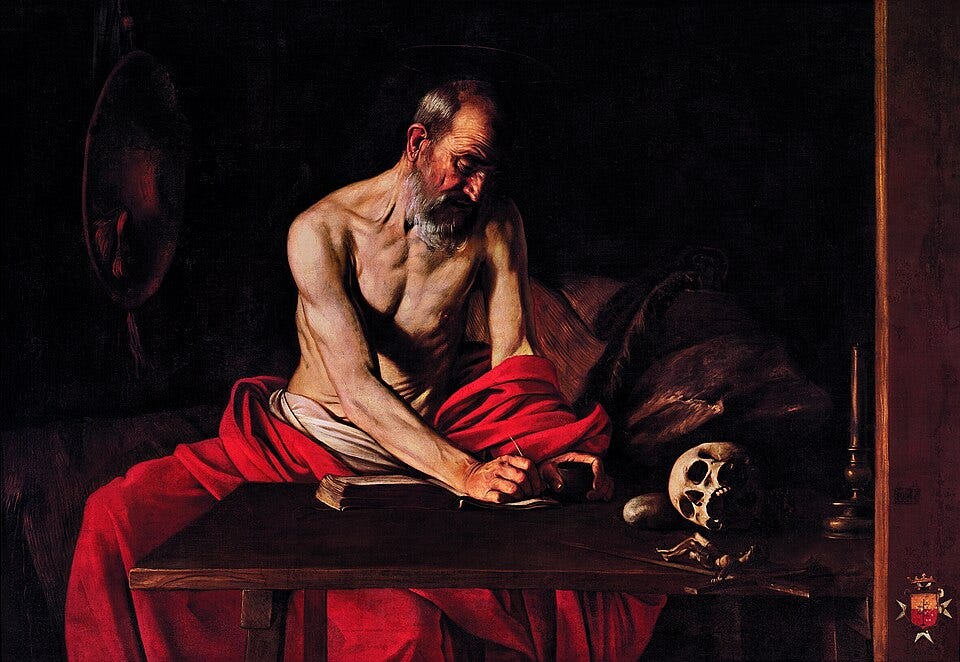
P.P.S. Caravaggio painted two works called Saint Jerome Writing. The first (below), commissioned in 1605 (the Rome version), depicts the saint deep in thought, his pen hovering above the page.
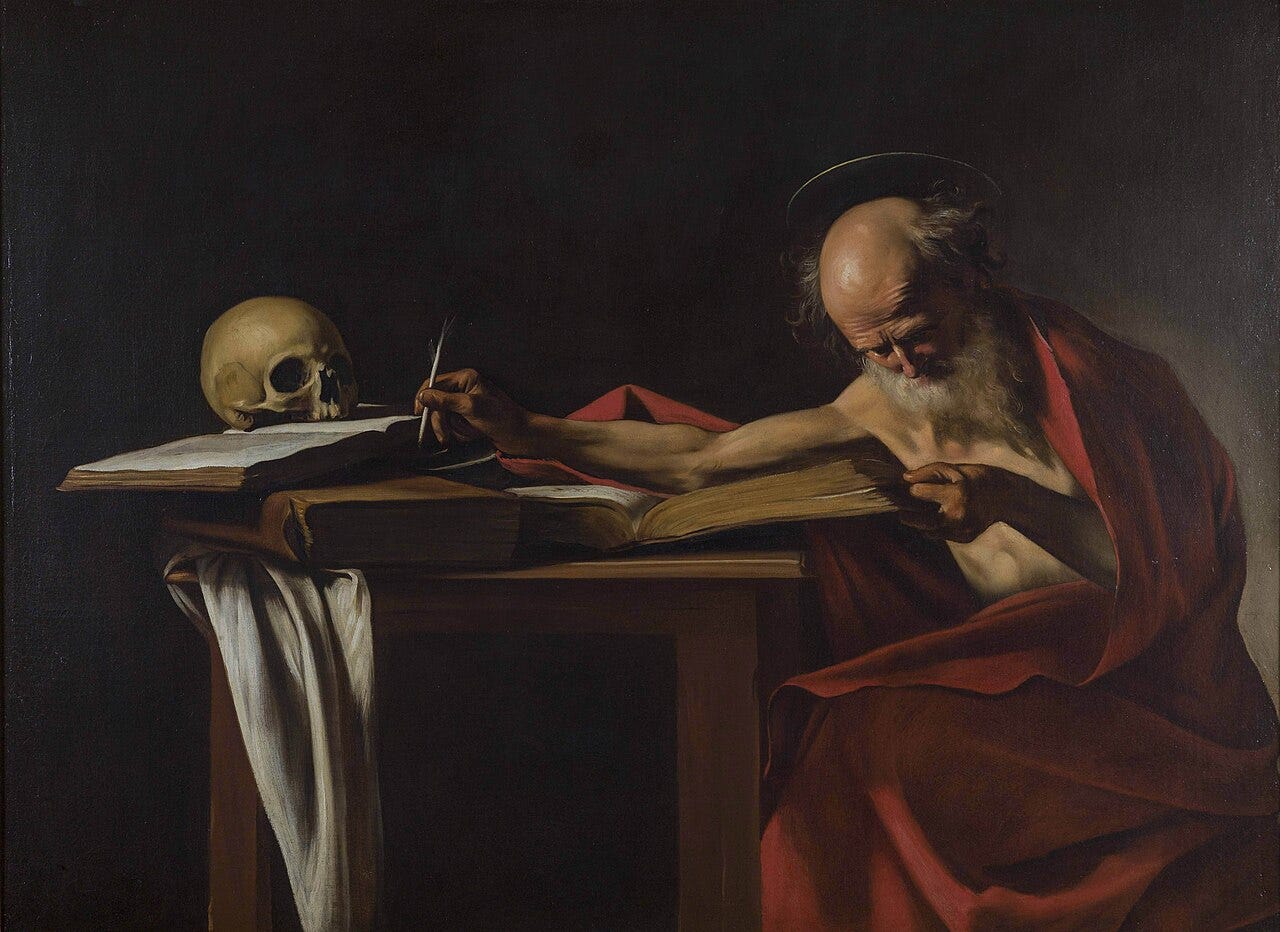
The second (which starts this essay) dates to around 1607 (the Malta version) and depicts Jerome writing. They both feature the saint sitting next to a skull and wrapped in a red cloak, but differ in their color palette and mood. I found it strange that Caravaggio would tackle the same subject twice in so short a time period, so I did a little research and found that the few years between these pieces were arguably the most chaotic of Caravaggio’s life.
Caravaggio painted the Rome version right around the time (1605) he killed a man named Ranuccio Tomassoni in a brawl. He fled his death sentence in Rome and arrived in Malta in 1607, where he painted the second version for Ippolito Malaspina, a high-ranking Knight of St. John, hoping the Knights would help secure a papal pardon for his crime. This strategy worked, earning him knighthood in Malta, until his temperament got the best of him and forced him to flee Malta much as he had fled Rome a few years before.
C.S. Lewis, Letter to Thomasine, December 14, 1959.
Letter to Thomasine.
Letter to Thomasine.
C.S. Lewis, Letter to Joan Lancaster, June 26, 1956.
C.S. Lewis, Studies in Words.
C.S. Lewis, Interview with Sherwood Wirt, May 7, 1963.
C.S. Lewis, On Science Fiction.
Chrétien de Troyes, Lancelot, The Knight of the Cart.
C.S. Lewis, Letter to Jane Gaskell, September 2, 1957.
C.S. Lewis, The Voyage of the Dawn Treader.
C.S. Lewis, The Lion, the Witch and the Wardrobe.
J.R.R. Tolkien, The Fellowship of the Ring.